Bahnhof Lage


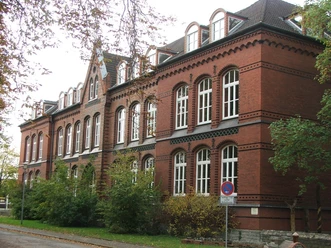
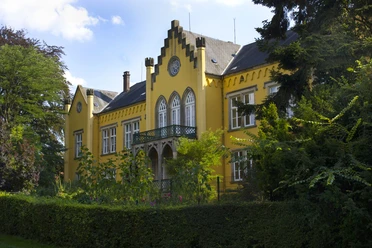
The Lage train station is located at the intersection of the lines from Herford to Detmold and from Bielefeld to Lemgo. It was designed as a small-town transfer station. The station building is a two-story structure built in a historicist style. It was constructed of brick.
In Lippe, the first trains began running in 1880 on the Herford–Lage–Detmold line. It was extended to Altenbeken in 1895. In 1903–1904, the Lage–Oerlinghausen–Bielefeld connection was added, turning Lage—which was already conveniently located—into a transportation hub. The connection to the increasingly dense railway network both within and outside the Lippe region was also of particular importance for the brick-making industry in Lage. This led to a shift in the transport of bricks from road to rail. During peak periods, the K.P.E.V. operated 5–6 special trains of exceptional length to transport the brickmakers. These brickmaker trains consisted mainly of livestock cars and fourth-class cars, known as “wood class.” Passengers could board the trains in Lage, Lemgo, and Schieder, among other places.
Due to its location on Sedanplatz, which has shaped the city’s urban landscape, as well as its documentary value regarding the city’s transportation and economic history, the station is of particular importance to Lage. Furthermore, due to its architectural design, the station building occupies an atypical and thus unique position in railway station architecture from the period after the turn of the century.
Today, you have several hourly connections on the regional network to Bielefeld, Herford, Lemgo, and Paderborn. Adjacent to the station building is a Park & Ride facility and a Bike & Ride facilities. The Central Bus Terminal (ZOB), built by the city of Lage in 2016, provides a coordinated, barrier-free transfer from rail to local public transit.
Good to know
Payment methods
- Entrance Free
Directions & Parking facilities
Contact person